Compound record · Longevity & mitochondrial
NAD+
Also Nicotinamide adenine dinucleotide · NAD · NAD plus
Coenzyme (not a peptide)
Endogenous coenzyme; the human trials are of oral precursors, not injected NAD+
Record reviewed 16 September 2026 · 7 references
In the AERVYN range
1 pen carries NAD+
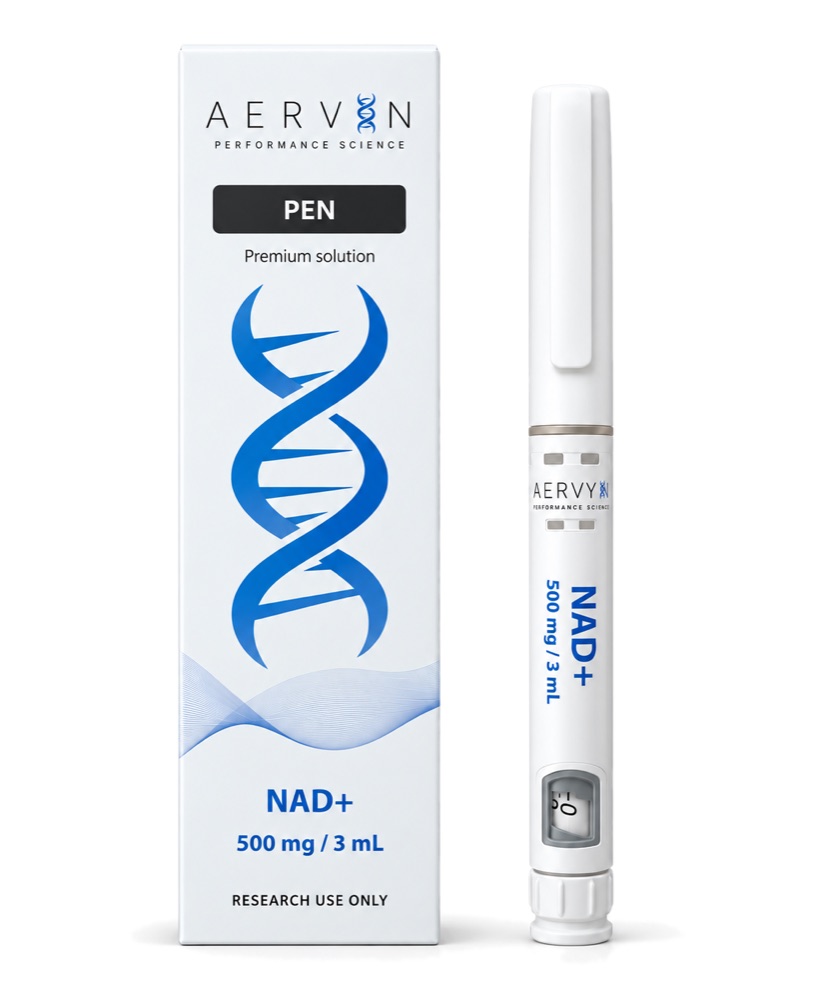
- Class
- Coenzyme (nicotinamide adenine dinucleotide) — not a peptide
- Human evidence
- Oral precursor trials (NR, NMN); one intravenous pharmacokinetic pilot (n = 11)
- Injected NAD+
- No controlled efficacy or safety trials
- Regulatory status
- Not an authorised medicine anywhere; oral supplement or compounded injectable
- Anti-doping
- Not on the WADA Prohibited List
01 Overview
What NAD+ is
Summary
Nicotinamide adenine dinucleotide (NAD+) is a coenzyme present in every living cell, where it carries electrons in energy metabolism and is consumed by enzymes involved in DNA repair and cell signalling. Tissue levels fall with age in animals and, by some measures, in people. Almost all human trial evidence concerns oral precursors — nicotinamide riboside (NR) and nicotinamide mononucleotide (NMN) — which reliably raise blood NAD+ but have produced few functional changes. Intravenous NAD+ has been studied in one small pharmacokinetic pilot; injectable or subcutaneous NAD+ has no controlled efficacy trials, and no form of NAD+ is an authorised medicine anywhere.
Mechanism
NAD+ cycles between its oxidised (NAD+) and reduced (NADH) forms to carry electrons through glycolysis, the citric-acid cycle and oxidative phosphorylation, and is the substrate for NAD+-consuming enzymes — sirtuins, PARPs and CD38 — that regulate DNA repair, gene expression and cell signalling. Supplementation aims to reverse the age-related fall in cellular NAD+. Whether injected NAD+ enters cells intact, or is broken down to nicotinamide and rebuilt inside the cell, is unresolved in humans.
02 Evidence by goal
What has been shown, for which goal
Grades follow one scale across the site. Limited overall means: small or short human studies, mixed results, or evidence mainly for a related use.
General wellbeing
LimitedOral precursors raise blood NAD+ (1 g/day of NR raised white-cell NAD+ by about 60% in 24 adults over six weeks) but most trials found no change in energy, fatigue or physical function. A 60-day trial of NMN in 80 middle-aged adults (300–900 mg/day) reported a longer six-minute walking distance and better self-rated general health at the higher doses. Nothing comparable exists for injected NAD+.
Longevity
LimitedThe rationale is the age-related decline in NAD+ shown in animals and some human tissues. Precursor trials have shown biomarker changes — NR raised blood NAD+ and, in exploratory analyses, trended towards lower blood pressure and aortic stiffness — but no trial has measured healthspan, disease incidence or lifespan in people, and several NR trials found no change in insulin sensitivity, mitochondrial function or body composition.
Athletic performance
InsufficientEndurance and recovery claims rest on rodent studies and on the walking-distance result in the NMN trial. NR trials in trained and untrained adults have not shown improved performance, and there are no human performance data for injected NAD+.
Sleep
InsufficientNAD+ is part of the molecular circadian clock, which underlies 'sleep and circadian' marketing. A 12-week trial of 250 mg NMN in 108 older adults found less afternoon drowsiness with afternoon dosing but no change in overall sleep quality; no trial has tested NAD+ itself with sleep as an outcome.
03 Regulatory status
Where it is authorised, and for what
Status is recorded per jurisdiction from regulator sources and reviewed by hand. It is never inferred from another region's decision.
United Kingdom
Not authorisedNot an authorised medicine; sold as a supplement (oral precursors) or as an unlicensed injectable.
No MHRA marketing authorisation exists for NAD+ or any precursor. Nicotinamide riboside chloride is an authorised novel food for use in supplements; NMN has no novel-food authorisation in Great Britain. NAD+ infusions offered by private clinics and injectable NAD+ sold online are unlicensed products whose quality, sterility and content are not assessed by the regulator.
04 Dosing research
What the evidence says about exposure
Published human studies and the doses, routes and durations they used — reported as research information, not a recommendation.
Research information — not a recommendation. These are the exposures used in published human studies, reported so you can see what has been tested. They are not dosing instructions and do not apply to any individual.
Study 01
Oral nicotinamide riboside (an NAD+ precursor, not NAD+ itself) in healthy middle-aged and older adults
Martens CR et al., Nat Commun 2018;9:1286 · Source
- Design
- Randomised, double-blind, placebo-controlled crossover (2 × 6 weeks)
- Population
- Healthy adults aged 55–79
- Participants
- n = 24
- Duration
- 6 weeks per arm
- Route
- Oral
- Doses studied
- Nicotinamide riboside chloride 500 mg twice daily (1,000 mg/day) by mouth
- Outcome at this exposure
- NAD+ in peripheral blood mononuclear cells rose by about 60% versus placebo. No significant change in cardiovascular or physical-function measures in the main analyses; exploratory analyses suggested lower systolic blood pressure and aortic stiffness in those with raised baseline blood pressure.
- Adverse events observed
- Well tolerated; no serious adverse events and no difference in treatment-emergent adverse events versus placebo. Three participants reported flushing.
Study 02
Oral nicotinamide mononucleotide (NMN, an NAD+ precursor) in healthy middle-aged adults
Yi L et al., GeroScience 2023;45:29–43 · Source
- Design
- Randomised, multicentre, double-blind, placebo-controlled, parallel-group
- Population
- Healthy adults aged 40–65
- Participants
- n = 80
- Duration
- 60 days
- Route
- Oral
- Doses studied
- NMN 300 mg, 600 mg or 900 mg once daily by mouth versus placebo
- Outcome at this exposure
- Blood NAD+ rose dose-dependently. Six-minute walking distance and self-rated general health (SF-36) improved significantly versus placebo at 600 mg and 900 mg by day 60; insulin resistance (HOMA-IR) did not change.
- Adverse events observed
- No safety signals; adverse events did not differ from placebo and blood chemistry stayed within normal ranges.
Study 03
Intravenous NAD+ — plasma and urine NAD+ metabolome during a 6-hour infusion (pilot)
Grant R et al., Front Aging Neurosci 2019;11:257 · Source
- Design
- Randomised to NAD+ or saline (8 : 3), open-label
- Population
- Healthy men aged 30–55 with BMI below 30
- Participants
- n = 11
- Duration
- Single 6-hour infusion, sampled to 8 hours
- Route
- Intravenous
- Doses studied
- 750 mg NAD+ in saline infused over 6 hours (about 2 mg/min) — a regimen copied from wellness-clinic practice
- Outcome at this exposure
- Plasma NAD+ and its metabolites were unchanged for the first 2 hours, then rose steeply by the end of the infusion (NAD+ roughly four-fold at 6 hours) and stayed raised at 8 hours; urinary excretion of NAD+ and methylnicotinamide peaked at 6 hours. The study measured exposure only — no clinical outcome.
- Adverse events observed
- No adverse events were observed in the eight infused participants; liver-enzyme activities fell slightly over 8 hours. The study was not designed or powered to assess safety.
The precursor trials show what oral NR and NMN did to blood NAD+ and to a handful of functional measures; they are not studies of NAD+ itself. The only human data on administered NAD+ are pharmacokinetic (the 6-hour infusion above) — there is no dose-finding, safety or efficacy trial of intravenous NAD+, and none at all of subcutaneous or intramuscular NAD+. Clinic and vendor regimens (for example 250–1,000 mg infused, or 50–200 mg injected subcutaneously several times a week) are empirical and have no trial basis.
05 Safety
Adverse effects and contraindications
Common effects seen in trials or reports, serious effects that warrant urgent review, and conditions under which use is not appropriate or needs assessment.
Common adverse effects
- Intravenous: flushing, nausea, chest tightness, abdominal cramping or headache during rapid infusion, usually easing when the rate is slowed (clinic reports; not measured in trials)
- Subcutaneous: injection-site pain, redness or bruising (user reports)
- Tiredness or a 'crash' in the hours after an infusion (user reports)
- Oral precursors: mild nausea, flushing, muscle aches or headache in trials, at rates similar to placebo
Serious adverse effects
- Severe chills, shaking, vomiting and fatigue after injectable NAD+ compounded from food-grade material — reported to the FDA and consistent with endotoxin contamination
- Unknown long-term effects — no controlled safety data for injected NAD+
- Theoretical effects on an existing cancer (NAD+-dependent DNA repair and cell metabolism)
- Infection or abscess from non-sterile injectable products
- Allergic or infusion reactions (reported anecdotally; frequency unknown)
Contraindications
- Cardiovascular diseaseCaution
Rapid intravenous NAD+ is reported to cause chest tightness, palpitations and flushing, and NR trials hint at blood-pressure effects. Heart disease, arrhythmia or uncontrolled blood pressure needs professional assessment before any parenteral NAD+.
- Kidney diseaseCaution
NAD+ and its metabolites are cleared by the kidney. High-dose exposure has not been studied in impaired renal function, and nicotinamide — the main breakdown product — can raise uric acid.
- CancerCaution
NAD+ supports the metabolism of rapidly dividing cells and PARP-mediated DNA repair. Whether raising NAD+ affects an existing or previous cancer is unknown in humans; PARP-inhibitor treatment is a specific theoretical conflict.
Do not use = should not be used · Caution = needs assessment
06 Interactions
Medicine classes that need review
Grouped by how seriously the combination should be taken. Class labels match the medicines questionnaire in the assessment.
- Major
- Moderate
- Minor
Moderate
Monitoring or dose review is usually advised.
Cancer treatment
Chemotherapy, hormone therapy, immunotherapy
Interactions are unstudied. PARP inhibitors (for example olaparib) act by competing with NAD+ at the enzyme, so raising NAD+ could in theory blunt them; disclose any NAD+ use to the treating oncologist.
Minor
Generally compatible; awareness is sufficient.
Blood pressure medicine
Ramipril, amlodipine, losartan
Exploratory NR data suggested small reductions in blood pressure, and rapid infusion causes transient haemodynamic symptoms. No formal interaction study exists; interactions with other medicine classes are simply unstudied.
07 Pregnancy & breastfeeding
Status in pregnancy
No human data on NAD+ infusions or injections in pregnancy or breastfeeding, and the precursor supplements have not been studied in pregnancy either. An unlicensed injectable is not appropriate while pregnant, trying to conceive or breastfeeding.
08 Monitoring
What is usually monitored
Parameters that trials and product information track. A clinician decides what applies to an individual.
- 01Whether tiredness has a treatable cause — thyroid, iron, B12, vitamin D, sleep disorders, mood — before it is attributed to NAD+ levels
- 02Blood pressure, heart rate and symptoms during any infusion
- 03Liver function and uric acid with repeated high-dose exposure (high-dose nicotinamide, an NAD+ metabolite, can affect both)
- 04Kidney function where there is any renal impairment
- 05Injection sites for infection or persistent reactions
- 06An objective measure of the goal — a fatigue scale, walk test or training log — against a realistic baseline
09 Combinations
What is known about combining it
Notes on pairing with other compounds in the directory: whether the combination has been studied in people, and where mechanisms overlap.
MOTS-c
No human studies
Overlap · Both are marketed for mitochondrial function and energy.
Sold together in 'mitochondrial' stacks. No human data on the combination; MOTS-c has no human efficacy data of its own, and the human data for NAD+ are for oral precursors.
BPC-157
No human studies
Marketed together in 'recovery' stacks. No human data on the combination, and neither has controlled human efficacy data for recovery.
GHK-Cu
No human studies
No human data on the combination and no shared mechanism has been demonstrated.
Tesamorelin
No human studies
Overlap · Both are promoted for healthy ageing and body composition.
No human studies of tesamorelin combined with NAD+ or its precursors.
FOXO4-DRI
No human studies
Overlap · Both are promoted for healthy ageing; NAD+ supports the DNA-repair and metabolic enzymes of cells that FOXO4-DRI is designed to remove.
No human data on the combination. The human evidence for NAD+ is for oral precursors, and FOXO4-DRI has none.
Discuss any proposed combination with a qualified healthcare professional.
10 Source considerations
Supply, quality and legitimacy
How the compound reaches people in practice, and what that means for product quality.
- 01No pharmaceutical-grade, authorised NAD+ product exists anywhere; injectable NAD+ comes from compounding pharmacies or from unregulated 'research' suppliers.
- 02NAD+ in solution is unstable — it degrades with heat, light and time — so cold-chain handling, lot dating and an assay of actual NAD+ content matter more than for most compounds.
- 03The FDA has warned that food-grade NAD+ used in sterile compounding has caused endotoxin-type reactions; sterility and endotoxin testing on every lot are the relevant safeguards.
- 04The precursor trials used defined products (nicotinamide riboside chloride, β-NMN); independent testing has found wide variation in the actual content of retail NAD+ and NMN supplements.
11 Questions for your clinician
Take these to your appointment
Specific to this compound. The personal assessment adds questions drawn from your own history and medicines.
- 01Has my tiredness or slow recovery been investigated — thyroid, iron, B12, vitamin D, sleep, mood — before I attribute it to NAD+?
- 02The human evidence is for oral precursors. Is there any reason to expect an injected form to do more?
- 03Is there anything in my history — heart disease, kidney disease, cancer or cancer treatment, gout — that makes raising NAD+ a concern?
- 04If I use an injectable product, what would you want to know about its sterility, endotoxin testing and NAD+ content?
- 05How would we measure whether it is doing anything, and when would we stop?
The personal assessment tailors this list to your responses.
12 References
Sources behind this record
Regulator documents and peer-reviewed publications used to derive every grade and statement above.
- 01Martens CR et al. Chronic nicotinamide riboside supplementation is well-tolerated and elevates NAD+ in healthy middle-aged and older adults. Nat Commun 2018;9:1286
- 02Yi L et al. The efficacy and safety of β-nicotinamide mononucleotide (NMN) supplementation in healthy middle-aged adults: a randomized, multicenter, double-blind, placebo-controlled, parallel-group, dose-dependent clinical trial. GeroScience 2023;45:29–43
- 03Grant R et al. A pilot study investigating changes in the human plasma and urine NAD+ metabolome during a 6 hour intravenous infusion of NAD+. Front Aging Neurosci 2019;11:257
- 04Kim M et al. Effect of 12-week intake of nicotinamide mononucleotide on sleep quality, fatigue, and physical performance in older Japanese adults: a randomized, double-blind placebo-controlled study. Nutrients 2022;14:755
- 05Dollerup OL et al. A randomized placebo-controlled clinical trial of nicotinamide riboside in obese men: safety, insulin-sensitivity, and lipid-mobilizing effects. Am J Clin Nutr 2018;108:343–353
- 06FDA — FDA reminds compounders to use ingredients suitable for sterile compounding (food-grade NAD+ in injectable products)
- 07FDA — Bulk drug substances nominated for use in compounding under section 503A (NAD in Category 1; updated May 2026)
The Peptide Checkup provides educational information and a structured summary of published research and regulatory status. It is not medical advice, does not diagnose or treat any condition, and does not replace a consultation with a qualified healthcare professional.
Personal assessment
Check NAD+ against your history
Seven minutes of structured questions about your goal, history and medicines, mapped against this record by a deterministic, clinician-reviewable rules engine. The report tells you when not to buy.