Compound record · Growth hormone axis
Tesamorelin
Also Egrifta · Egrifta SV · Egrifta WR · TH9507 · Tesa
Synthetic GHRH analogue
Licensed GHRH analogue that reduces visceral fat in HIV-associated lipodystrophy
Record reviewed 1 September 2026 · 6 references
In the AERVYN range
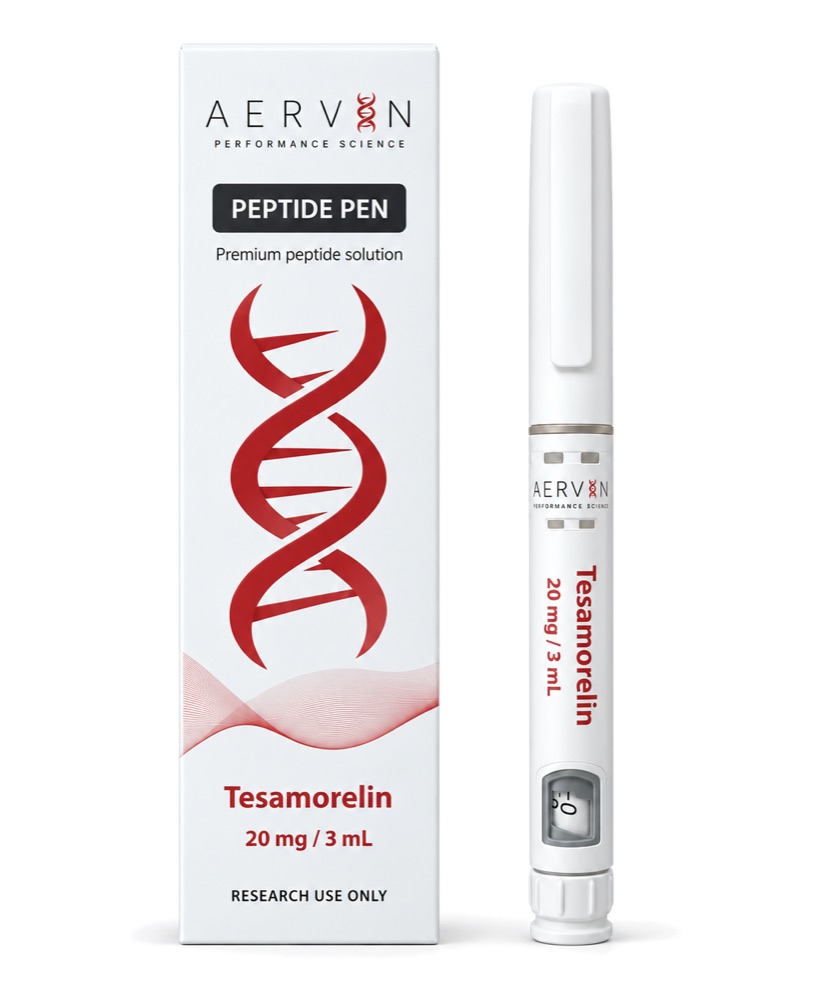
1 pen carries Tesamorelin
- Class
- Synthetic GHRH analogue
- Route
- Daily subcutaneous injection
- Licensed for
- Visceral fat in HIV-associated lipodystrophy (US, Canada)
- Trial effect
- ≈ 15% visceral fat reduction at 26 weeks; reverses on stopping
- Not authorised
- UK, EU (application withdrawn 2012), Australia
01 Overview
What Tesamorelin is
Summary
Tesamorelin is a stabilised synthetic analogue of growth-hormone-releasing hormone (GHRH 1–44) that prompts the pituitary to release the body's own growth hormone. It is approved in the United States and Canada for one narrow indication — reducing excess abdominal (visceral) fat in adults with HIV who have lipodystrophy — on the basis of two 26-week Phase 3 trials. It is not authorised in the UK, EU or Australia, and the US label states that it is not indicated for weight-loss management.
Mechanism
Binds GHRH receptors on pituitary somatotroph cells, stimulating pulsatile release of endogenous growth hormone, which raises IGF-1 and promotes breakdown of fat, particularly visceral fat. Because release stays under normal feedback control, GH pulsatility is preserved, unlike with injected growth hormone. A trans-3-hexenoic acid modification protects the peptide from rapid enzymatic breakdown.
02 Evidence by goal
What has been shown, for which goal
Grades follow one scale across the site. Strong overall means: multiple large randomised controlled trials or regulatory approval for this use.
Fat loss / body composition
ModerateIn two Phase 3 trials in adults with HIV-associated abdominal fat accumulation (pooled n = 806), 2 mg daily reduced visceral adipose tissue by about 15% relative to placebo at 26 weeks, with no change in subcutaneous fat, and the fat returned within months of stopping. Evidence outside HIV lipodystrophy is limited to one 12-month trial of 60 adults with abdominal obesity, which showed a similar visceral-fat reduction without weight change.
Longevity
PreliminaryA 12-month randomised trial in 61 people with HIV and fatty liver disease reduced liver fat by about a third (absolute change −4.1 percentage points versus placebo) and fewer participants progressed in fibrosis. No data exist on cardiovascular events or lifespan, and the label notes that long-term cardiovascular safety has not been established.
Weight management
InsufficientBody weight was essentially unchanged in the trials — tesamorelin shifts visceral fat rather than reducing overall weight — and the US label states that it is not indicated for weight-loss management.
Muscle & recovery
InsufficientSmall gains in lean mass were secondary findings in the HIV trials; there are no studies of strength, recovery or training adaptation in any population.
03 Regulatory status
Where it is authorised, and for what
Status is recorded per jurisdiction from regulator sources and reviewed by hand. It is never inferred from another region's decision.
United Kingdom
Not authorisedNot authorised by the MHRA; no UK marketing authorisation has ever been granted.
Tesamorelin has never held a UK licence. Any supply would be an unlicensed import on a named-patient basis under the prescriber's responsibility; vials sold online as 'research chemicals' are not medicines and are not quality-assured.
04 Dosing research
What the evidence says about exposure
Published human studies and the doses, routes and durations they used — reported as research information, not a recommendation.
Research information — not a recommendation. These are the exposures used in published human studies, reported so you can see what has been tested. They are not dosing instructions and do not apply to any individual.
Study 01
Pivotal Phase 3 — tesamorelin in HIV-infected adults with abdominal fat accumulation
Falutz J et al., N Engl J Med 2007;357:2359–2370 · Source
- Design
- Randomised, double-blind, placebo-controlled
- Population
- Adults with HIV on stable antiretroviral therapy with excess abdominal fat (86% men)
- Participants
- n = 412
- Duration
- 26 weeks
- Route
- Subcutaneous injection
- Doses studied
- 2 mg once daily
- Outcome at this exposure
- Visceral adipose tissue changed −15.2% with tesamorelin vs +5.0% with placebo; triglycerides fell 50 mg/dL vs a rise of 9 mg/dL; IGF-1 rose 81% vs −5%. No significant differences in glucose measures.
- Adverse events observed
- Overall adverse-event rates did not differ significantly, but more tesamorelin participants withdrew because of an adverse event; injection-site reactions, arthralgia and peripheral oedema were the most frequent drug-related events.
Study 02
Pooled analysis of the two Phase 3 trials with 26-week safety extension
Falutz J et al., J Clin Endocrinol Metab 2010;95:4291–4304
- Design
- Pooled analysis of two randomised, double-blind, placebo-controlled trials; re-randomised extension to 52 weeks
- Population
- Adults with HIV-associated abdominal fat accumulation (543 tesamorelin, 263 placebo)
- Participants
- n = 806
- Duration
- 26 weeks, then 26-week extension
- Route
- Subcutaneous injection
- Doses studied
- 2 mg once daily; at week 26 tesamorelin recipients were re-randomised to continue or switch to placebo
- Outcome at this exposure
- Visceral fat −24 cm² vs +2 cm² at 26 weeks (treatment effect −15.4%); subcutaneous fat unchanged; IGF-1 +108 ng/mL vs +7 ng/mL. Those continuing to 52 weeks kept a −17.5% reduction; those switched to placebo regained visceral fat towards baseline within 13 weeks.
- Adverse events observed
- Injection-site reactions (17% vs 6%), arthralgia (13% vs 11%), peripheral oedema (6% vs 2%), myalgia and paraesthesia; hypersensitivity reactions in 4%. HbA1c reached ≥ 6.5% in 5% vs 1% (hazard ratio 3.3). About half of participants developed anti-tesamorelin antibodies without loss of effect.
Study 03
Tesamorelin for non-alcoholic fatty liver disease in HIV
Stanley TL et al., Lancet HIV 2019;6:e821–e830 · Source
- Design
- Randomised, double-blind, placebo-controlled, multicentre
- Population
- Adults with HIV and hepatic fat fraction ≥ 5% on MR spectroscopy
- Participants
- n = 61
- Duration
- 12 months (then 6-month open-label phase)
- Route
- Subcutaneous injection
- Doses studied
- 2 mg once daily
- Outcome at this exposure
- Hepatic fat fraction fell by an absolute 4.1 percentage points more than placebo (37% relative reduction); 35% vs 4% reached a hepatic fat fraction below 5%. Fasting glucose and HbA1c did not differ between groups.
- Adverse events observed
- More localised injection-site complaints with tesamorelin; none judged serious.
All efficacy data come from adults with HIV. The newer Egrifta WR formulation delivers 1.28 mg daily and was approved on pharmacokinetic bioequivalence to the original 2 mg dose rather than on new outcome trials.
05 Safety
Adverse effects and contraindications
Common effects seen in trials or reports, serious effects that warrant urgent review, and conditions under which use is not appropriate or needs assessment.
Common adverse effects
- Injection-site reactions (redness, itching, pain, bruising) — about 1 in 6
- Joint pain (arthralgia) and limb pain
- Peripheral oedema and fluid retention
- Muscle aches and stiffness
- Tingling or numbness (paraesthesia)
- Raised blood glucose
- Rash or itching (hypersensitivity in about 4%)
- Nausea and vomiting
- Night sweats
Serious adverse effects
- New-onset diabetes or glucose intolerance (HbA1c ≥ 6.5% in 5% vs 1% with placebo)
- Persistent IGF-1 elevation (above 3 standard deviations in about a third at 26 weeks) with unknown long-term effects
- Hypersensitivity reactions including urticaria
- Carpal tunnel syndrome and other fluid-retention complications
- Possible acceleration of an existing malignancy (contraindicated in active cancer)
- Worsening of diabetic retinopathy
- Increased mortality when GH-axis agents are given during acute critical illness (class warning)
Contraindications
- CancerDo not use
Contraindicated with active malignancy — tesamorelin raises GH and IGF-1, which are growth factors. Previous cancer must be inactive with treatment complete, and the label advises stopping if any recurrence is suspected.
- Hormonal disorderDo not use
Contraindicated where the hypothalamic–pituitary axis is disrupted (hypopituitarism, pituitary tumour or surgery, head irradiation or head trauma), because it cannot work without a functioning pituitary. Other hormonal disorders need specialist assessment.
- Acromegaly or pituitary tumourDo not use
Stimulating further GH release in acromegaly or with a pituitary tumour is inappropriate; these conditions fall under the label contraindication for pituitary disease.
- DiabetesCaution
Tesamorelin can cause glucose intolerance; in the trials, new HbA1c ≥ 6.5% occurred in 5% vs 1% with placebo. Glucose status should be evaluated before starting and monitored throughout.
- Diabetic retinopathy (eye disease)Caution
Because IGF-1 rises, the label asks for regular retinal monitoring in people with diabetes for development or worsening of retinopathy.
- Cardiovascular diseaseCaution
Long-term cardiovascular safety has not been established; fluid retention can occur, and GH-axis stimulation is advised against in acute critical illness (for example after cardiac or abdominal surgery).
Do not use = should not be used · Caution = needs assessment
06 Interactions
Medicine classes that need review
Grouped by how seriously the combination should be taken. Class labels match the medicines questionnaire in the assessment.
- Major
- Moderate
- Minor
Major
Combination should be reviewed by a prescriber before use.
Growth hormone
Somatropin
Duplicate GH-axis stimulation: injected growth hormone suppresses the pituitary response that tesamorelin relies on, and IGF-1 exposure becomes additive. No safety data for the combination.
Moderate
Monitoring or dose review is usually advised.
Corticosteroid
Prednisolone, dexamethasone, hydrocortisone
GH increases cortisol clearance (via 11β-HSD1); people on glucocorticoid replacement may need dose adjustment, and glucocorticoids raise glucose alongside tesamorelin.
Insulin
Lantus, NovoRapid, Humalog, Tresiba
Tesamorelin opposes insulin action; glucose monitoring and possible insulin adjustment are advised.
Sulfonylurea
Gliclazide, glimepiride, glipizide
Glucose control may deteriorate; monitoring is advised when starting or stopping tesamorelin.
Minor
Generally compatible; awareness is sufficient.
Other glucose-lowering medicine
Metformin, SGLT2 inhibitors, DPP-4 inhibitors
Glucose-lowering effect may be partly offset; monitoring advised.
Hormone replacement therapy
Oestrogen, progesterone
Oral oestrogens blunt hepatic IGF-1 generation, which may reduce the response to GH-axis stimulation.
Oral contraceptive
Combined pill, progestogen-only pill
Oral oestrogen-containing contraceptives may blunt the IGF-1 response; no formal interaction study.
Anti-epileptic
Lamotrigine, levetiracetam, valproate
GH can alter cytochrome P450 clearance of medicines such as anticonvulsants; the label advises monitoring when combined.
Narrow-therapeutic-index medicine
Lithium, digoxin, ciclosporin
Clearance of ciclosporin and other CYP450-metabolised narrow-margin medicines may change; closer level monitoring advised.
07 Pregnancy & breastfeeding
Status in pregnancy
Contraindicated in pregnancy: visceral fat normally increases during pregnancy, modifying it offers no benefit, and animal studies showed fetal harm. Breastfeeding data are lacking; the label advises against use.
08 Monitoring
What is usually monitored
Parameters that trials and product information track. A clinician decides what applies to an individual.
- 01IGF-1 at baseline and periodically — the label suggests reconsidering treatment if levels stay above 3 standard deviations
- 02Fasting glucose and HbA1c before starting and at regular intervals
- 03Retinal examination in anyone with diabetes
- 04Waist circumference or imaging response at 26 weeks — treatment is usually reassessed if visceral fat has not fallen
- 05Swelling, joint pain and hand tingling (fluid retention)
- 06Blood pressure and any symptoms of hypersensitivity
- 07Age- and HIV-appropriate cancer screening
09 Combinations
What is known about combining it
Notes on pairing with other compounds in the directory: whether the combination has been studied in people, and where mechanisms overlap.
Sermorelin
No human studies
Overlap · Both are GHRH analogues acting on the same pituitary receptor.
Duplicate GHRH stimulation with no human data; there is no rationale for combining two GHRH analogues.
CJC-1295
No human studies
Overlap · Both are GHRH analogues; CJC-1295 adds days-long receptor stimulation.
Duplicate mechanism, no safety data, and CJC-1295 is an unlicensed research chemical.
Ipamorelin
No human studies
Overlap · Both raise GH and IGF-1 via complementary receptors (GHRH and ghrelin receptor).
No clinical trials of tesamorelin with any GH secretagogue; additive IGF-1 exposure and glucose effects are expected.
Somatropin
No human studies
Overlap · Duplicate GH-axis stimulation; injected GH suppresses the pituitary response tesamorelin depends on.
No rationale or data for combining; IGF-1 and glucose effects would be additive.
IGF-1 LR3
No human studies
Overlap · Additive IGF-1 activity from an unlicensed analogue with no human data.
No human data; combines a monitored, licensed medicine with an untested laboratory reagent.
Semaglutide
No human studies
Overlap · Both are used for body-fat goals but act through unrelated mechanisms.
No human studies of GHRH analogues combined with GLP-1 medicines; tesamorelin is not licensed for weight loss.
Tirzepatide
No human studies
Overlap · Both are used for body-fat goals; GH-axis stimulation raises glucose while incretins lower it.
No human data on the combination.
BPC-157
No human studies
Marketed together as 'recovery' stacks; no human data on the combination and BPC-157 lacks human efficacy data.
NAD+
No human studies
Overlap · Both are promoted for healthy ageing and body composition.
No human studies of tesamorelin combined with NAD+ or its precursors.
Gonadorelin
No human studies
Overlap · Both are hypothalamic releasing-hormone analogues (GHRH and GnRH) acting on different pituitary cells.
Marketed together in 'hormone optimisation' protocols. No human data on the combination; each stimulates a separate pituitary axis and there is no reason to expect one to help the other.
Discuss any proposed combination with a qualified healthcare professional.
10 Source considerations
Supply, quality and legitimacy
How the compound reaches people in practice, and what that means for product quality.
- 01Prescription-only in the US and Canada and unavailable as a licensed medicine in the UK, EU and Australia — legitimate supply outside North America is effectively limited to unlicensed import under a prescriber.
- 02Two non-substitutable formulations exist (Egrifta SV 2 mg daily; Egrifta WR 1.28 mg daily) with different reconstitution and storage instructions — a common source of dosing confusion.
- 03'Research chemical' tesamorelin vials are not the authorised product, are not tested for identity, sterility or potency, and are frequently mislabelled.
- 04The product requires reconstitution with the supplied bacteriostatic water and correct storage; degraded peptide loses activity.
11 Questions for your clinician
Take these to your appointment
Specific to this compound. The personal assessment adds questions drawn from your own history and medicines.
- 01Do I meet the licensed indication (HIV-associated lipodystrophy with excess abdominal fat)? If not, what is the legal and evidence basis for using it in my country?
- 02What are my baseline IGF-1, fasting glucose and HbA1c, and how often will they be rechecked?
- 03Do I have any pituitary history, cancer history or diabetic eye disease that rules this out?
- 04How will we judge whether it is working at 26 weeks, and what happens to visceral fat when I stop?
- 05Which formulation and dose is being prescribed, and how is it reconstituted and stored?
- 06Are any of my medicines — steroids, diabetes medicines, oral oestrogen — likely to interact?
The personal assessment tailors this list to your responses.
12 Alternatives
Compounds with stronger evidence or firmer regulatory footing
Listed for overlapping goals. Whether any is appropriate depends on your history — the assessment maps that for you.
Metabolic (incretin-based)
Semaglutide
GLP-1 receptor agonist
Once-weekly incretin medicine with the largest weight-management evidence base
StrongApproved medicine (for specific indications)Metabolic (incretin-based)
Tirzepatide
Dual GIP/GLP-1 receptor agonist
Once-weekly dual incretin with the largest weight loss among authorised medicines
StrongApproved medicine (for specific indications)
13 References
Sources behind this record
Regulator documents and peer-reviewed publications used to derive every grade and statement above.
- 01Falutz J et al. Metabolic effects of a growth hormone-releasing factor in patients with HIV. NEJM 2007
- 02Falutz J et al. Pooled analysis of two Phase 3 trials with safety extension. J Clin Endocrinol Metab 2010;95:4291–4304
- 03Stanley TL et al. Tesamorelin for NAFLD in HIV. Lancet HIV 2019
- 04Makimura H et al. Tesamorelin in obese adults with reduced GH secretion (12-month RCT). J Clin Endocrinol Metab 2012
- 05Egrifta WR US Prescribing Information (FDA, March 2025)
- 06EMA — Egrifta: withdrawal of the marketing authorisation application (2012)
The Peptide Checkup provides educational information and a structured summary of published research and regulatory status. It is not medical advice, does not diagnose or treat any condition, and does not replace a consultation with a qualified healthcare professional.
Personal assessment
Check Tesamorelin against your history
Seven minutes of structured questions about your goal, history and medicines, mapped against this record by a deterministic, clinician-reviewable rules engine. The report tells you when not to buy.