Compound record · Longevity & mitochondrial
MOTS-c
Also MOTS-C · Mitochondrial open reading frame of the 12S rRNA-c · Mitochondrial-derived peptide · CB4211 (analogue)
Mitochondrial-derived 16-amino-acid peptide
Mitochondrial 'exercise mimetic' peptide: mouse data only, WADA-prohibited
Record reviewed 1 September 2026 · 6 references
In the AERVYN range
1 pen carries MOTS-c
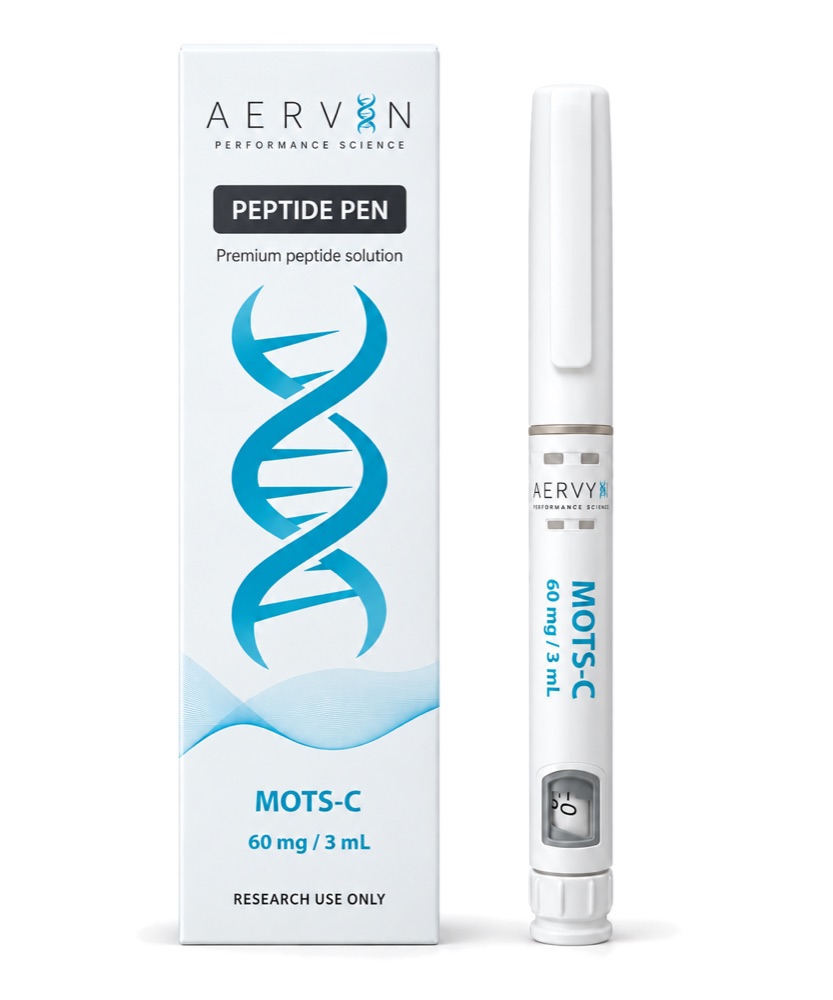
- Class
- Mitochondrial-derived peptide (16 amino acids)
- Route
- Subcutaneous injection ('research' vials)
- Human trials
- None of MOTS-c; one 4-week phase 1b of an analogue (≈ 20 participants)
- Authorised
- Nowhere
- WADA
- Prohibited at all times (S4.4 metabolic modulators, named explicitly)
01 Overview
What MOTS-c is
Summary
MOTS-c is a 16-amino-acid peptide encoded within the mitochondrial genome that acts as a metabolic signalling molecule. In mice it improves insulin sensitivity, prevents diet-induced obesity and increases exercise capacity, including in old animals. In humans, circulating levels change with age and exercise, and an analogue (CB4211) completed a small phase 1 study, but MOTS-c itself has never been tested for efficacy in people. It is not authorised anywhere and is explicitly prohibited by WADA at all times.
Mechanism
Activates AMP-activated protein kinase (AMPK) via the folate–methionine cycle, increasing glucose uptake and fatty-acid oxidation in skeletal muscle; under metabolic stress it moves to the nucleus and regulates stress-response genes. These findings are from cell and mouse studies.
02 Evidence by goal
What has been shown, for which goal
Grades follow one scale across the site. Insufficient overall means: no reliable human evidence for this use — animal or laboratory data only.
Longevity
InsufficientLate-life MOTS-c treatment improved physical capacity and healthspan markers in old mice. In humans, endogenous levels have been associated with age and exercise in observational studies (Reynolds et al. 2021), but no trial has given MOTS-c to people for any ageing outcome.
Fat loss / body composition
InsufficientPrevents diet-induced obesity and improves insulin sensitivity in mice. The analogue CB4211 showed only a trend towards lower body weight and a small glucose reduction over four weeks in 20 people with obesity and fatty liver; no human study of MOTS-c itself exists.
Athletic performance
InsufficientIncreased running capacity in young and old mice underlies 'exercise mimetic' marketing. There are no human performance studies, and MOTS-c is named on the WADA Prohibited List, so use by tested athletes constitutes doping.
03 Regulatory status
Where it is authorised, and for what
Status is recorded per jurisdiction from regulator sources and reviewed by hand. It is never inferred from another region's decision.
United Kingdom
Not authorisedNot authorised as a medicine; sold only as an unregulated 'research chemical'.
04 Dosing research
What the evidence says about exposure
Published human studies and the doses, routes and durations they used — reported as research information, not a recommendation.
Research information — not a recommendation. These are the exposures used in published human studies, reported so you can see what has been tested. They are not dosing instructions and do not apply to any individual.
Study 01
CB4211 (a MOTS-c analogue, not MOTS-c) — phase 1a/1b in healthy adults and obesity with fatty liver
CohBar Inc., topline results August 2021; AASLD The Liver Meeting 2021 late-breaking poster (not peer-reviewed)
- Design
- Phase 1a: double-blind, placebo-controlled single and multiple ascending doses; phase 1b: randomised, double-blind, placebo-controlled
- Population
- Phase 1a: 65 healthy adults; phase 1b: adults with BMI ≥ 30 and non-alcoholic fatty liver disease (≥ 10% liver fat)
- Participants
- n = 85
- Duration
- Up to 7 days (phase 1a); 4 weeks (phase 1b)
- Route
- Subcutaneous injection
- Doses studied
- Phase 1a: 0.2–3.0 mg/kg/day; phase 1b: 25 mg once daily by subcutaneous injection versus placebo (about 20 participants randomised 1:1)
- Outcome at this exposure
- Primary safety endpoint met. In phase 1b, ALT and AST fell significantly versus placebo, fasting glucose fell by about 6% versus no change, and there was a non-significant trend to lower body weight; liver fat fell similarly in both groups. No further trials have been reported and the sponsor did not progress the programme.
- Adverse events observed
- No serious adverse events; mild-to-moderate injection-site reactions were the only treatment-related adverse event in more than 10% of participants.
No human dosing study of MOTS-c itself has been published; the FDA stated in 2023 that it had identified no human exposure data. The CB4211 study above concerns a modified analogue and is not comparable to 'research chemical' MOTS-c. Vendor regimens (for example 5–10 mg two to three times weekly) are extrapolated from mouse doses and are not evidence.
05 Safety
Adverse effects and contraindications
Common effects seen in trials or reports, serious effects that warrant urgent review, and conditions under which use is not appropriate or needs assessment.
Common adverse effects
- Injection-site reactions (the main adverse event seen with the analogue CB4211)
- Headache
- Fatigue or, anecdotally, restlessness
Serious adverse effects
- Immune reactions to peptide impurities in unregulated products (flagged by the FDA)
- Hypoglycaemia if combined with glucose-lowering medicines (theoretical)
- Injection-related infection with non-sterile products
- Anti-doping violation for tested athletes (prohibited at all times)
Contraindications
- DiabetesCaution
Marketed for its insulin-sensitising effect in mice. Any glucose-lowering effect in people using insulin or other diabetes medicines is unpredictable and unstudied.
- CancerCaution
Effects of a metabolic and nuclear stress-response modulator on existing malignancy are unknown; no human safety data.
Do not use = should not be used · Caution = needs assessment
06 Interactions
Medicine classes that need review
Grouped by how seriously the combination should be taken. Class labels match the medicines questionnaire in the assessment.
- Major
- Moderate
- Minor
Moderate
Monitoring or dose review is usually advised.
Insulin
Lantus, NovoRapid, Humalog, Tresiba
Interactions are unstudied. Additive glucose lowering is a theoretical concern given the AMPK-activating, insulin-sensitising mechanism in animals.
Other glucose-lowering medicine
Metformin, SGLT2 inhibitors, DPP-4 inhibitors
Interactions are unstudied. Metformin also acts partly via AMPK; combined effects on glucose are unknown.
Sulfonylurea
Gliclazide, glimepiride, glipizide
Interactions are unstudied; theoretical additive hypoglycaemia risk.
07 Pregnancy & breastfeeding
Status in pregnancy
No human or animal reproductive safety data; use in pregnancy or breastfeeding cannot be assessed.
08 Monitoring
What is usually monitored
Parameters that trials and product information track. A clinician decides what applies to an individual.
- 01Fasting glucose or HbA1c, particularly if diabetes medicines are used
- 02Body weight and body-composition trend against a realistic baseline
- 03Exercise capacity using an objective, repeatable measure
- 04Injection sites for reactions or infection
- 05Anti-doping status if competing in any tested sport
09 Combinations
What is known about combining it
Notes on pairing with other compounds in the directory: whether the combination has been studied in people, and where mechanisms overlap.
Epitalon
No human studies
Overlap · Both are marketed as 'longevity' peptides.
Commonly sold together in longevity stacks; no human data on either compound alone or in combination.
Elamipretide
No human studies
Overlap · Both are mitochondria-targeted peptides.
No human data on combining them; elamipretide's approved use is a rare mitochondrial disease and MOTS-c has no human efficacy data.
Semaglutide
No human studies
Overlap · Both are promoted for metabolic health and fat loss.
No human data. Any additive glucose-lowering effect is theoretical; semaglutide alone has strong evidence for the shared goal.
Tirzepatide
No human studies
Overlap · Both are promoted for metabolic health and fat loss.
No human data. Any additive glucose-lowering effect is theoretical; tirzepatide alone has strong evidence for the shared goal.
Ipamorelin
No human studies
Marketed together in 'body composition' stacks; no human data on the combination.
NAD+
No human studies
Overlap · Both are marketed for mitochondrial function and energy.
Sold together in 'mitochondrial' stacks. No human data on the combination; MOTS-c has no human efficacy data, and the human data for NAD+ are for oral precursors.
FOXO4-DRI
No human studies
Overlap · Both appear in 'cellular ageing' stacks; MOTS-c targets mitochondrial metabolism, FOXO4-DRI senescent cells.
No human data on the combination; neither has human efficacy data of its own.
Discuss any proposed combination with a qualified healthcare professional.
10 Source considerations
Supply, quality and legitimacy
How the compound reaches people in practice, and what that means for product quality.
- 01Every product available is an unregulated 'research chemical'; the FDA has flagged immunogenicity and impurity risks and the absence of human exposure data.
- 02Independent testing has found peptide 'research' vials with incorrect identity or quantity; certificates of analysis from the seller are not independent verification.
- 03Possession or use may breach anti-doping rules for competitive athletes regardless of source.
11 Questions for your clinician
Take these to your appointment
Specific to this compound. The personal assessment adds questions drawn from your own history and medicines.
- 01Is there any human evidence that MOTS-c improves fat loss, fitness or ageing, as opposed to mouse data?
- 02How would this affect my blood glucose alongside my current medicines?
- 03Which options with actual human evidence for body composition or metabolic health should be considered first?
- 04What are the anti-doping implications if I compete in any tested sport?
- 05How would we monitor for benefit or harm, and when would we stop?
The personal assessment tailors this list to your responses.
12 Alternatives
Compounds with stronger evidence or firmer regulatory footing
Listed for overlapping goals. Whether any is appropriate depends on your history — the assessment maps that for you.
Metabolic (incretin-based)
Semaglutide
GLP-1 receptor agonist
Once-weekly incretin medicine with the largest weight-management evidence base
StrongApproved medicine (for specific indications)Metabolic (incretin-based)
Tirzepatide
Dual GIP/GLP-1 receptor agonist
Once-weekly dual incretin with the largest weight loss among authorised medicines
StrongApproved medicine (for specific indications)
13 References
Sources behind this record
Regulator documents and peer-reviewed publications used to derive every grade and statement above.
- 01Lee C et al. The mitochondrial-derived peptide MOTS-c promotes metabolic homeostasis and reduces obesity and insulin resistance. Cell Metab 2015
- 02Reynolds JC et al. MOTS-c is an exercise-induced mitochondrial-encoded regulator of age-dependent physical decline and muscle homeostasis. Nat Commun 2021
- 03CohBar Inc. Topline results from the phase 1a/1b study of CB4211 (press release, August 2021)
- 04WADA 2026 Prohibited List (S4.4.1 names MOTS-c)
- 05USADA — What is the MOTS-c peptide?
- 06FDA — Bulk drug substances that may present significant safety risks (503A Category 2)
The Peptide Checkup provides educational information and a structured summary of published research and regulatory status. It is not medical advice, does not diagnose or treat any condition, and does not replace a consultation with a qualified healthcare professional.
Personal assessment
Check MOTS-c against your history
Seven minutes of structured questions about your goal, history and medicines, mapped against this record by a deterministic, clinician-reviewable rules engine. The report tells you when not to buy.