Compound record · Immune
KPV
Also Lys-Pro-Val · α-MSH (11–13) · alpha-MSH fragment
Anti-inflammatory tripeptide (α-MSH fragment)
α-MSH tripeptide with anti-inflammatory animal data and no human trials
Record reviewed 16 September 2026 · 6 references
In the AERVYN range
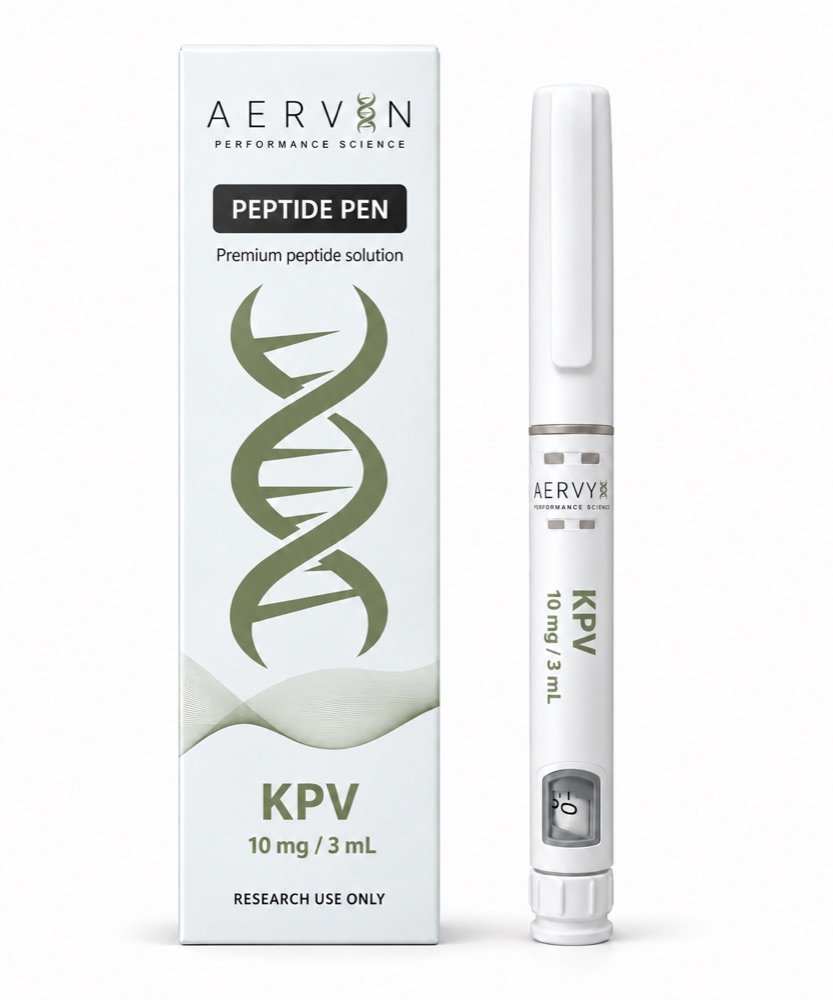
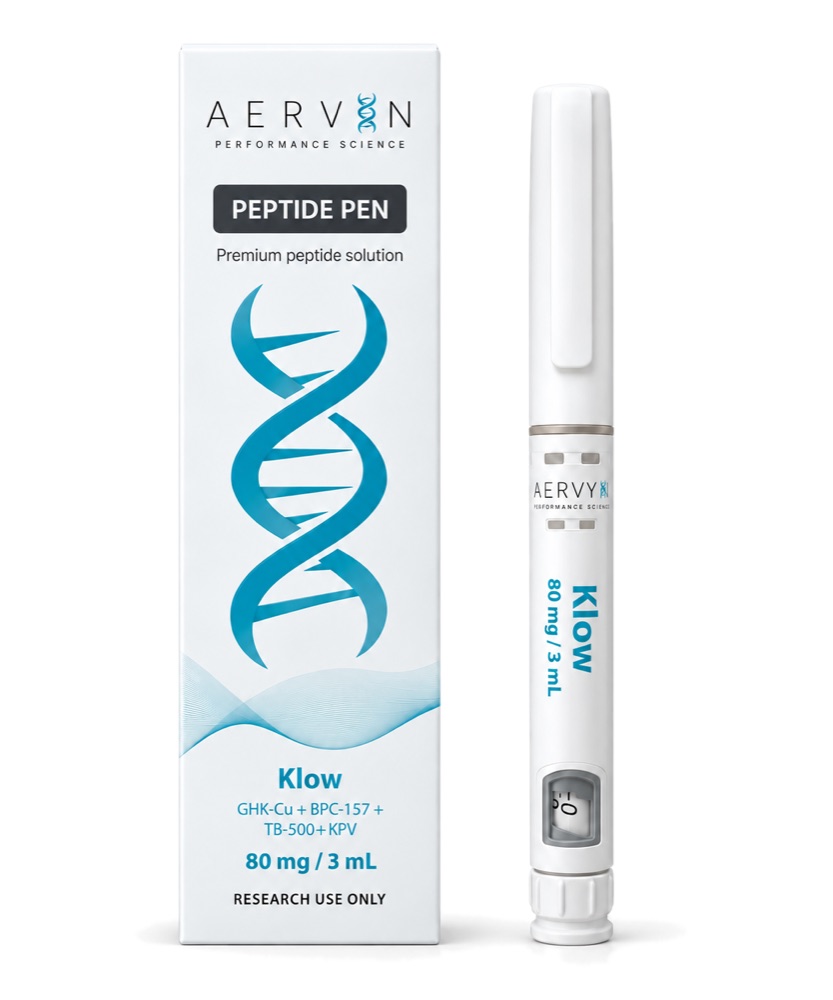
2 pens carry KPV
- Class
- Tripeptide fragment (residues 11–13) of α-MSH
- Human trials
- None published, by any route
- Regulatory status
- Not authorised anywhere; US advisory vote (8–6) pending FDA rulemaking
- Anti-doping
- Not listed by name; S0 applies to non-approved substances for tested athletes
- Typical sale form
- Unregulated vials, capsules and blends
01 Overview
What KPV is
Summary
KPV (lysine-proline-valine) is the C-terminal tripeptide of α-melanocyte-stimulating hormone (α-MSH), a hormone that dampens inflammation as well as driving skin pigmentation. In laboratory and mouse models the fragment keeps the anti-inflammatory activity without the pigmenting effect, and reduces intestinal and skin inflammation. No human trial of KPV has been published for any use, it is not an authorised medicine anywhere, and the FDA's 2026 review found no human exposure data for any route of administration.
Mechanism
In cell and animal studies KPV is taken into cells by the peptide transporter PepT1 and reduces NF-κB activation and the release of inflammatory cytokines such as TNF-α, IL-6 and IL-8; unlike full-length α-MSH it does not activate melanocortin-1 receptors on melanocytes, so it has no pigmenting effect. The molecular target behind its anti-inflammatory action has not been identified, and none of this has been confirmed in humans.
02 Evidence by goal
What has been shown, for which goal
Grades follow one scale across the site. Insufficient overall means: no reliable human evidence for this use — animal or laboratory data only.
Skin & cosmetic
Insufficientα-MSH-derived peptides reduce inflammation in mouse models of contact dermatitis and improve wound closure in rodents; an in-vitro study found that KPV does not penetrate intact human skin without microneedling or iontophoresis. There are no human studies of KPV for skin ageing, acne, eczema or wound healing.
Injury & recovery support
InsufficientRepair claims rest on the anti-inflammatory and wound-healing effects of α-MSH peptides in rodents. No study — animal or human — has examined KPV in tendon, ligament, muscle or joint injury.
General wellbeing
InsufficientMarketed for gut health, 'systemic inflammation' and mast-cell symptoms. Oral KPV reduced experimental colitis in mice in two 2008 studies, but no human trial in inflammatory bowel disease or any other condition has been published.
03 Regulatory status
Where it is authorised, and for what
Status is recorded per jurisdiction from regulator sources and reviewed by hand. It is never inferred from another region's decision.
United Kingdom
Not authorisedNo marketing authorisation; sold online as a 'research chemical'.
No MHRA-licensed medicine contains KPV and it cannot legally be sold or advertised for human use. Products labelled 'for research use only' fall outside medicines quality controls, so identity, purity and sterility are unverified.
04 Dosing research
What the evidence says about exposure
Published human studies and the doses, routes and durations they used — reported as research information, not a recommendation.
Research information — not a recommendation. These are the exposures used in published human studies, reported so you can see what has been tested. They are not dosing instructions and do not apply to any individual.
No studies recorded
No published human dosing studies
No human study of KPV has been published by any route — no pharmacokinetics, dose-finding, safety or efficacy data — and the FDA's July 2026 briefing document found none either. The mouse colitis studies gave KPV in drinking water or in oral nanoparticles at exposures that cannot be translated to a human dose. Vendor regimens (commonly 200–500 mcg injected daily, or oral capsules) have no evidential basis.
05 Safety
Adverse effects and contraindications
Common effects seen in trials or reports, serious effects that warrant urgent review, and conditions under which use is not appropriate or needs assessment.
Common adverse effects
- Not studied in humans
- Injection-site pain, redness or itching (user reports)
- Nausea or headache (user reports)
Serious adverse effects
- Unknown — no human safety data by any route
- Immune reactions to the peptide, aggregates or impurities (the FDA's stated concern for this class of compounded peptide)
- Masked or worsened infection from immune suppression (theoretical)
- Infection from non-sterile injectable products
Contraindications
- Autoimmune conditionCaution
KPV is an immunomodulator in laboratory models, and injected peptides carry an immunogenicity risk that has not been assessed for KPV. Effects in autoimmune disease or alongside immune-modifying treatment are unknown.
- Active infectionCaution
A peptide that suppresses inflammatory signalling could in theory blunt the response to infection. There are no human data either way.
Do not use = should not be used · Caution = needs assessment
06 Interactions
Medicine classes that need review
Grouped by how seriously the combination should be taken. Class labels match the medicines questionnaire in the assessment.
- Major
- Moderate
- Minor
Moderate
Monitoring or dose review is usually advised.
Immunosuppressant / biologic
Methotrexate, tacrolimus, adalimumab
Theoretical additive immune suppression from combining an anti-inflammatory peptide with immunosuppressant or biologic therapy; entirely unstudied in humans.
Corticosteroid
Prednisolone, dexamethasone, hydrocortisone
Both dampen inflammatory signalling; combined effects, and any masking of infection, are unstudied.
07 Pregnancy & breastfeeding
Status in pregnancy
No human or reproductive-toxicity data exist. An unlicensed peptide of unknown purity is not something to use while pregnant, trying to conceive or breastfeeding.
08 Monitoring
What is usually monitored
Parameters that trials and product information track. A clinician decides what applies to an individual.
- 01Injection sites for infection or persistent reactions
- 02Any new or worsening infection, given the anti-inflammatory mechanism
- 03Whether a diagnosed inflammatory condition is being self-treated in place of assessed care
- 04An objective measure of the skin or repair goal against a realistic baseline
- 05Anti-doping status if you compete in tested sport (not named on the Prohibited List, but non-approved substances fall under S0)
09 Combinations
What is known about combining it
Notes on pairing with other compounds in the directory: whether the combination has been studied in people, and where mechanisms overlap.
GHK-Cu
No human studies
Overlap · Both are marketed for skin repair — GHK-Cu for collagen and remodelling, KPV for inflammation.
Commonly blended, as in the Klow pen. There is no human study of either injected compound alone, let alone together.
BPC-157
No human studies
Overlap · Both carry anti-inflammatory and repair claims derived from animal models.
No human data on the combination; neither has published human efficacy trials.
TB-500
No human studies
No human data on the combination; TB-500 has no human data at all.
Discuss any proposed combination with a qualified healthcare professional.
10 Source considerations
Supply, quality and legitimacy
How the compound reaches people in practice, and what that means for product quality.
- 01No authorised, pharmaceutical-grade KPV exists anywhere; every vial, capsule or cream comes from a compounding pharmacy or an unregulated supplier.
- 02The FDA's 2026 review judged KPV 'not well-characterised': naming is inconsistent (free base versus acetate salt), and no public data exist on impurities, aggregates or microbiological quality.
- 03In blends such as the Klow pen, KPV is one of four components; the lot certificate should confirm identity and quantity of each component separately.
- 04Because KPV barely penetrates intact skin, topical products would need a penetration strategy to reach deeper skin layers — a formulation question that vendors rarely address.
11 Questions for your clinician
Take these to your appointment
Specific to this compound. The personal assessment adds questions drawn from your own history and medicines.
- 01Has the inflammatory or skin problem I want to address been diagnosed, and what are the authorised treatments with actual human evidence?
- 02Given that there are no human studies of KPV at all, what would you need to see before considering it reasonable?
- 03Does my history — autoimmune disease, current infection, immune-modifying medicines — make an immunomodulating peptide a particular concern?
- 04If I have already used KPV, are there any checks you would recommend?
The personal assessment tailors this list to your responses.
12 Alternatives
Compounds with stronger evidence or firmer regulatory footing
Listed for overlapping goals. Whether any is appropriate depends on your history — the assessment maps that for you.
13 References
Sources behind this record
Regulator documents and peer-reviewed publications used to derive every grade and statement above.
- 01Kannengiesser K et al. Melanocortin-derived tripeptide KPV has anti-inflammatory potential in murine models of inflammatory bowel disease. Inflamm Bowel Dis 2008;14:324–331
- 02Dalmasso G et al. PepT1-mediated tripeptide KPV uptake reduces intestinal inflammation. Gastroenterology 2008;134:166–178
- 03Brzoska T et al. Alpha-melanocyte-stimulating hormone and related tripeptides: biochemistry, antiinflammatory and protective effects in vitro and in vivo, and future perspectives for the treatment of immune-mediated inflammatory diseases. Endocr Rev 2008;29:581–602
- 04FDA — Briefing document for KPV-related bulk drug substances (KPV free base and KPV acetate), Pharmacy Compounding Advisory Committee, 23–24 July 2026
- 05FDA — July 23–24, 2026 meeting of the Pharmacy Compounding Advisory Committee (agenda, briefing materials and votes)
- 06FDA — Certain bulk drug substances for use in compounding that may present significant safety risks (September 2023 listing; KPV removed April 2026)
The Peptide Checkup provides educational information and a structured summary of published research and regulatory status. It is not medical advice, does not diagnose or treat any condition, and does not replace a consultation with a qualified healthcare professional.
Personal assessment
Check KPV against your history
Seven minutes of structured questions about your goal, history and medicines, mapped against this record by a deterministic, clinician-reviewable rules engine. The report tells you when not to buy.