Compound record · Metabolic (incretin-based)
Retatrutide
Also LY3437943 · Reta · Triple G · GGG tri-agonist · GLP-3
GIP/GLP-1/glucagon receptor triple agonist
Investigational triple agonist with the largest trial weight loss reported so far
Record reviewed 1 September 2026 · 5 references
In the AERVYN range
1 pen carries Retatrutide
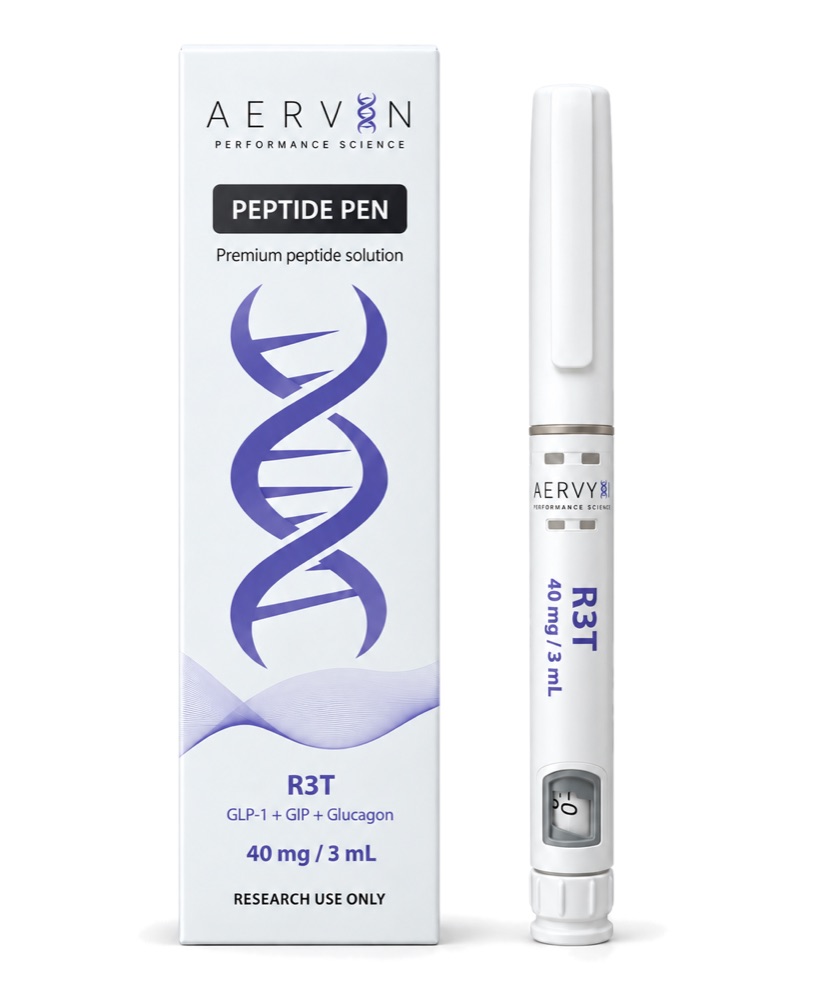
- Status
- Investigational — phase 3 (TRIUMPH); not authorised anywhere
- Class
- GIP/GLP-1/glucagon receptor triple agonist
- Route
- Weekly subcutaneous injection (trials only)
- Phase 2 weight loss
- ≈ 24% mean at 48 weeks (12 mg)
- Prescription
- Not available by prescription; clinical trials only
01 Overview
What Retatrutide is
Summary
Retatrutide (LY3437943) is an investigational once-weekly peptide that activates GIP, GLP-1 and glucagon receptors. In a 48-week phase 2 trial the 12 mg dose produced a mean 24.2% weight reduction, and manufacturer-announced phase 3 (TRIUMPH) results in 2025–2026 reported mean losses of roughly 21–28% at 80 weeks depending on the population. It is not authorised anywhere; Eli Lilly has said it plans to file for US approval in the first quarter of 2027.
Mechanism
Combines GLP-1 and GIP receptor activity (appetite suppression, slowed gastric emptying, glucose-dependent insulin release) with glucagon receptor agonism, which increases energy expenditure and liver fat oxidation. The glucagon component is thought to add weight and liver-fat reduction but also raises heart rate and can raise glucose, which the incretin components counterbalance.
02 Evidence by goal
What has been shown, for which goal
Grades follow one scale across the site. Moderate overall means: at least one well-conducted randomised trial or consistent controlled human studies.
Weight management
ModeratePhase 2 (n = 338): mean weight loss of 8.7%, 17.1%, 22.8% and 24.2% at 48 weeks with 1, 4, 8 and 12 mg weekly versus 2.1% with placebo; every participant on 8 or 12 mg lost ≥ 5%. Phase 3 TRIUMPH trials have reported positive topline results (12.7–20.8% at 80 weeks in type 2 diabetes; up to 22.6% with established cardiovascular disease; approximately 28% in obesity without diabetes), but full peer-reviewed publication and regulatory review are pending.
Fat loss / body composition
LimitedIn an MRI sub-study of the phase 2 obesity trial (n = 98 with liver fat ≥ 10%), liver fat fell by roughly 80–86% at 48 weeks with 8–12 mg; whole-body fat-versus-lean-mass data have not yet been fully published.
Longevity
PreliminaryTRIUMPH-3 (n = 1,949, severe obesity with established cardiovascular disease) met its weight-loss endpoint and improved blood pressure, lipids and CRP, but cardiovascular events were too few to show benefit (MACE-5 hazard ratio 0.82, 95% CI 0.55–1.22; MACE-3 1.12). A dedicated cardiovascular and renal outcomes trial is ongoing; no outcome data exist yet.
03 Regulatory status
Where it is authorised, and for what
Status is recorded per jurisdiction from regulator sources and reviewed by hand. It is never inferred from another region's decision.
United Kingdom
InvestigationalNot authorised; in phase 3 trials (TRIUMPH programme).
No MHRA marketing authorisation. Retatrutide is available only within clinical trials; products sold online as 'retatrutide' are unregulated, of unverified identity and purity, and cannot lawfully be supplied as a medicine.
04 Dosing research
What the evidence says about exposure
Published human studies and the doses, routes and durations they used — reported as research information, not a recommendation.
Research information — not a recommendation. These are the exposures used in published human studies, reported so you can see what has been tested. They are not dosing instructions and do not apply to any individual.
Study 01
Phase 2 — retatrutide in adults with obesity
Jastreboff AM et al., N Engl J Med 2023;389:514–526 · Source
- Design
- Randomised, double-blind, placebo-controlled, dose-finding
- Population
- Adults without diabetes with BMI ≥ 30, or 27–30 with ≥ 1 weight-related condition
- Participants
- n = 338
- Duration
- 48 weeks
- Route
- Subcutaneous injection
- Doses studied
- 1 mg, 4 mg (starting 2 or 4 mg), 8 mg (starting 2 or 4 mg) or 12 mg (starting 2 mg) once weekly, escalated in 4-week steps
- Outcome at this exposure
- Mean weight change at 48 weeks −8.7% (1 mg), −17.1% (4 mg), −22.8% (8 mg) and −24.2% (12 mg) vs −2.1% with placebo; 100% of participants on 8 or 12 mg lost ≥ 5% and 83% on 12 mg lost ≥ 15%.
- Adverse events observed
- Dose-related gastrointestinal events (nausea, diarrhoea, vomiting, constipation), mostly mild-to-moderate and partly mitigated by the lower 2 mg starting dose; discontinuation for adverse events 6–16% vs 0% with placebo; heart rate rose dose-dependently to a peak at 24 weeks then declined; cardiac arrhythmias were mostly mild-to-moderate (one severe QT prolongation in a participant also taking ondansetron); skin hyperaesthesia or sensitivity in 7% vs 1%; one case of acute pancreatitis.
Study 02
Phase 2 — retatrutide in adults with type 2 diabetes
Rosenstock J et al., Lancet 2023;402:529–544 · Source
- Design
- Randomised, double-blind, placebo- and active-controlled (dulaglutide 1.5 mg)
- Population
- Adults with type 2 diabetes and BMI 25–50 on diet and exercise with or without metformin
- Participants
- n = 281
- Duration
- 36 weeks
- Route
- Subcutaneous injection
- Doses studied
- 0.5 mg, 4 mg, 8 mg or 12 mg once weekly (several starting-dose and escalation schedules) vs placebo or dulaglutide 1.5 mg weekly
- Outcome at this exposure
- HbA1c fell by up to approximately 2.0 percentage points at 24 weeks (vs ≈ 0 with placebo and 1.4 with dulaglutide); weight fell by up to approximately 17% at 36 weeks with 12 mg vs 3.0% with placebo and 2.0% with dulaglutide.
- Adverse events observed
- Mostly mild-to-moderate, dose-related gastrointestinal events; increased heart rate; no severe hypoglycaemia reported.
Phase 3 TRIUMPH trials (more than 5,800 participants, 80 weeks, target doses 4, 9 and 12 mg reached in 4-week steps from 2 mg) have reported topline results but had not been published in peer-reviewed form at last review. Discontinuation for adverse events in TRIUMPH-2 and -3 ranged from about 4% to 13.5% versus about 5% with placebo.
05 Safety
Adverse effects and contraindications
Common effects seen in trials or reports, serious effects that warrant urgent review, and conditions under which use is not appropriate or needs assessment.
Common adverse effects
- Nausea
- Diarrhoea
- Vomiting
- Constipation
- Reduced appetite
- Abdominal pain and dyspepsia
- Increased heart rate
- Skin sensitivity, tingling or altered sensation (dysaesthesia)
- Fatigue
- Injection-site reactions
- Headache
Serious adverse effects
- Cardiac arrhythmias (reported in phase 2; mostly mild-to-moderate, one severe QT prolongation)
- Sustained heart-rate increase
- Acute pancreatitis (one case in phase 2; class effect)
- Gallbladder disease with rapid weight loss (class effect)
- Acute kidney injury from dehydration (class effect)
- Severe hypoglycaemia when combined with insulin or sulfonylureas
- Unknown long-term safety — no data beyond 80 weeks
- Aspiration during anaesthesia due to retained stomach contents (class warning)
Contraindications
- Personal or family history of medullary thyroid cancer or MEN2Do not use
Trials exclude people with a personal or family history of medullary thyroid carcinoma or MEN2, and authorised incretin medicines carry a thyroid C-cell warning; treated as a class contraindication.
- Previous pancreatitisDo not use
Trials exclude people with previous pancreatitis; acute pancreatitis was reported in the phase 2 obesity trial and is a class effect of incretin medicines.
- Gastroparesis (slow stomach emptying)Do not use
Slows gastric emptying further; excluded from trials and treated as a class contraindication.
- Thyroid diseaseCaution
Any thyroid cancer history must be clarified; slowed gastric emptying may change levothyroxine absorption.
- Pancreatic diseaseCaution
Pancreatic disease warrants specialist assessment before considering any incretin-based compound.
- Gallbladder diseaseCaution
Gallstone disease is more common with rapid, large weight loss; the weight loss seen with retatrutide is larger than with authorised incretins.
- DiabetesCaution
Hypoglycaemia risk rises with insulin or sulfonylureas; glucagon receptor activation can raise glucose. Type 1 diabetes has not been studied.
- Diabetic retinopathy (eye disease)Caution
Rapid glucose improvement can temporarily worsen retinopathy with incretin medicines; no retatrutide-specific data.
- Kidney diseaseCaution
Dehydration from vomiting or diarrhoea can cause acute kidney injury; renal outcomes are being studied but are unknown.
- Gastrointestinal diseaseCaution
Not studied in severe gastrointestinal disease; slowed gastric emptying may worsen symptoms.
- Cardiovascular diseaseCaution
Heart-rate increases are larger than with single GLP-1 agonists and arrhythmia events were reported in phase 2; people with arrhythmia, QT prolongation or unstable cardiovascular disease need specialist review.
- Mental health conditionCaution
Authorised weight-management medicines carry monitoring advice for depression and suicidal thoughts; no retatrutide-specific data.
- Current or previous eating disorderCaution
Potent appetite suppression requires specialist assessment where there is a current or previous eating disorder.
Do not use = should not be used · Caution = needs assessment
06 Interactions
Medicine classes that need review
Grouped by how seriously the combination should be taken. Class labels match the medicines questionnaire in the assessment.
- Major
- Moderate
- Minor
Major
Combination should be reviewed by a prescriber before use.
Insulin
Lantus, NovoRapid, Humalog, Tresiba
Combined use would increase hypoglycaemia risk; insulin adjustment has only been studied within trials.
Sulfonylurea
Gliclazide, glimepiride, glipizide
Combined use would increase hypoglycaemia risk; trials required dose adjustment under supervision.
GLP-1 / incretin medicine
Ozempic, Wegovy, Mounjaro, Saxenda
Retatrutide already contains GLP-1 and GIP receptor activity — adding another incretin medicine duplicates mechanism with no safety data.
Moderate
Monitoring or dose review is usually advised.
Oral contraceptive
Combined pill, progestogen-only pill
No human interaction data. Tirzepatide, which shares GIP/GLP-1 activity, reduces oral-contraceptive exposure, so a barrier or non-oral method is a reasonable precaution to discuss.
Anticoagulant (blood thinner)
Warfarin, apixaban, rivaroxaban
Delayed gastric emptying can alter absorption; closer INR monitoring would be prudent with warfarin.
Thyroid hormone
Levothyroxine, liothyronine
Levothyroxine exposure may change with slowed gastric emptying.
Narrow-therapeutic-index medicine
Lithium, digoxin, ciclosporin
Medicines that depend on rapid absorption or have a narrow therapeutic window may need closer monitoring.
Minor
Generally compatible; awareness is sufficient.
Beta blocker
Bisoprolol, propranolol, atenolol
No interaction studies; beta-blockers may mask the heart-rate increase seen with retatrutide.
Other glucose-lowering medicine
Metformin, SGLT2 inhibitors, DPP-4 inhibitors
Studied alongside metformin in trials; glucose monitoring advised.
07 Pregnancy & breastfeeding
Status in pregnancy
No human data; trials exclude pregnant and breastfeeding women and require effective contraception. Authorised incretin medicines are not recommended in pregnancy, and the long half-life means a wash-out period would be expected.
08 Monitoring
What is usually monitored
Parameters that trials and product information track. A clinician decides what applies to an individual.
- 01Heart rate and rhythm, particularly during dose escalation
- 02Gastrointestinal tolerability and hydration at every dose step
- 03Kidney function during vomiting or diarrhoea
- 04Blood glucose if on insulin or sulfonylureas
- 05Skin sensations (dysaesthesia) and mood
- 06Muscle mass, nutrition and protein intake during rapid weight loss
09 Combinations
What is known about combining it
Notes on pairing with other compounds in the directory: whether the combination has been studied in people, and where mechanisms overlap.
Semaglutide
No human studies
Overlap · Retatrutide already includes GLP-1 receptor activity.
No rationale or data for combining with another GLP-1 medicine; duplicate mechanism.
Tirzepatide
No human studies
Overlap · Both act on GIP and GLP-1 receptors.
Duplicate mechanism with no human data; two incretin medicines should not be combined.
Liraglutide
No human studies
Overlap · Both include GLP-1 receptor activity.
Duplicate mechanism with no human data.
Cagrilintide
No human studies
Overlap · Both suppress appetite and slow gastric emptying.
Cagrilintide has only been studied with semaglutide; a triple agonist plus an amylin analogue has never been tested in humans.
Survodutide
No human studies
Overlap · Both include glucagon and GLP-1 receptor activity.
Duplicate mechanism; both are investigational and neither has been studied in combination.
CJC-1295
No human studies
No human studies of incretin-based compounds combined with growth-hormone secretagogues.
Ipamorelin
No human studies
No human studies of incretin-based compounds combined with growth-hormone secretagogues.
BPC-157
No human studies
No human data on this combination; BPC-157 itself lacks human efficacy data.
Discuss any proposed combination with a qualified healthcare professional.
10 Source considerations
Supply, quality and legitimacy
How the compound reaches people in practice, and what that means for product quality.
- 01No authorised product exists anywhere — every vial sold as 'retatrutide' is unregulated, with no assurance of identity, purity, sterility or dose.
- 02The only lawful route of access is enrolment in a registered clinical trial; the manufacturer states it cannot legally be sold or marketed for human use.
- 03Regulators including the FDA and MHRA have warned about unapproved GLP-1-type products sold online and through social media.
- 04Athletes: retatrutide is not named on the WADA Prohibited List, but WADA's S0 category covers pharmacological substances without regulatory approval for human use; competitors should seek anti-doping advice.
11 Questions for your clinician
Take these to your appointment
Specific to this compound. The personal assessment adds questions drawn from your own history and medicines.
- 01Is there a clinical trial of retatrutide I could be eligible for in my country?
- 02Given that tirzepatide and semaglutide are authorised, what would retatrutide add for my goal?
- 03How would heart rate, rhythm and kidney function be monitored with a compound that has no label?
- 04What is known about what happens to weight after stopping?
- 05If a product were obtained outside a trial, how could its identity and sterility be verified?
The personal assessment tailors this list to your responses.
12 Alternatives
Compounds with stronger evidence or firmer regulatory footing
Listed for overlapping goals. Whether any is appropriate depends on your history — the assessment maps that for you.
Metabolic (incretin-based)
Tirzepatide
Dual GIP/GLP-1 receptor agonist
Once-weekly dual incretin with the largest weight loss among authorised medicines
StrongApproved medicine (for specific indications)Metabolic (incretin-based)
Semaglutide
GLP-1 receptor agonist
Once-weekly incretin medicine with the largest weight-management evidence base
StrongApproved medicine (for specific indications)
13 References
Sources behind this record
Regulator documents and peer-reviewed publications used to derive every grade and statement above.
- 01Jastreboff AM et al. Retatrutide phase 2 in obesity. NEJM 2023
- 02Rosenstock J et al. Retatrutide phase 2 in type 2 diabetes. Lancet 2023
- 03Sanyal AJ et al. Retatrutide and liver fat (phase 2 sub-study). Nat Med 2024
- 04Eli Lilly — TRIUMPH-2 and TRIUMPH-3 topline results (press release, July 2026)
- 05ClinicalTrials.gov — retatrutide studies
The Peptide Checkup provides educational information and a structured summary of published research and regulatory status. It is not medical advice, does not diagnose or treat any condition, and does not replace a consultation with a qualified healthcare professional.
Personal assessment
Check Retatrutide against your history
Seven minutes of structured questions about your goal, history and medicines, mapped against this record by a deterministic, clinician-reviewable rules engine. The report tells you when not to buy.